

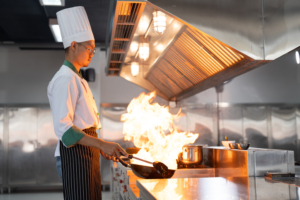
Traditionally, the path to becoming a chef meant moving to culinary hubs like New York City or Paris.
Technology has opened doors for those seeking a career in the culinary arts without the need to relocate or even travel to a campus to learn.
Online education is becoming a mainstay in most industries.
Today’s aspiring chefs can hone their skills at home, working in their own kitchens.
They continue to learn from some of the world’s top chefs and train at leading culinary schools.
Online learning simply makes the road to becoming a professional chef or baker more accessible.
Best Online Culinary & Pastry Training Programs
Choosing the right online program is an important part of meeting your career goals as a chef or baker.
Consider some of the top-tier schools in the industry.
Auguste Escoffier School of Culinary Arts
The Escoffier School frequently ranks among the top five culinary schools globally.
It is the only U.S. culinary school that offers 100% online learning for culinary and pastry degrees.
They teach students classical French techniques and focus on a farm-to-table philosophy.
Escoffier offers six different categories in its culinary program.
They include:
- Culinary Arts: 60 weeks of training to become a professional chef
- Baking & Pastry: 60 weeks of training to become a professional baker
- Food Entrepreneurship: Individual training plans that focus on running a business.
- Plant-Based Culinary: For chefs who wish to specialize in vegan cooking
- Holistic Nutrition & Wellness: For chefs who want to focus on holistic nutrition.
- Hospitality & Restaurant Operations Management: For those pursuing management positions.
Cost: Tuition varies by program of study.
A diploma in Culinary Arts and Operations costs $23,980.
They also offer an Associate’s Degree program that costs $36,225.
There are no application fees included for either training program.
How It Works: Students training at Escoffier complete weekly assignments working in their own kitchen.
They document their work via video and photos to receive instructor feedback.
The program also includes an industry externship for hands-on training in a commercial environment.
Institute of Culinary Education (ICE)
ICE has a reputation for excellence globally in culinary education.
In 2021, they launched an online diploma program in Culinary Arts & Food Operations.
The goal was to provide students with a more flexible option.
Today, this school provides eight separate online programs for aspiring culinary professionals.
They include:
- Culinary Arts & Food Operations: A 16-month program with 90 hours of intensive curriculum. There is also an Associate’s Degree program that takes 22 months to complete.
- Health-Centered Culinary Arts: A 16-month program that focuses on health-supportive techniques. ICE also offers this as an Associate’s Degree program that lasts 22 months.
- Baking & Pastry Arts & Food Operations: A 16-month program in pastry and baking arts. They also provide this program with an Associate’s Degree.
- Restaurant & Culinary Management: This training lasts 7–13 months and is for those seeking a management role.
- Tourism, Travel & Hospitality Management: An 8 or 12-month course of study that highlights the hospitality industry.
Cost: Online diploma programs run from $14,408 to $18,574.
Associate’s Degree courses cost from $25,070 to $25,324.
Each program also includes approximately $2,000 in books and fees.
How It Works: Students watch videos on demand or live.
They also do culinary labs and projects.

Rouxbe Online Culinary School
Rouxbe is a team of chef educators and culinary executives who teach entirely online.
It is the school of choice for Marriott and Fairmont when they train their staff.
This school breaks down its training programs into four classifications:
- Classical
- Plant-based
- Baking & Pastry
- Specialty
Each classification offers its own courses.
For example, the Classical program includes Seafood Literacy and Professional Cook.
Students pay a price for each course.
They also offer a monthly subscription plan that allows students to take as many classes as they want.
For this reason, the school appeals to a wide range of students, including home cooks.
Cost: Each classification offers both home and professional courses.
The home course costs only a couple of hundred dollars.
The professional courses are more extensive and offer college credits.
They cost more than $1,200 or more.
The subscription service provides students with unlimited access to a wide range of courses and recipes, along with chef-led support.
A basic subscription is $30 a month.
How It Works: Rouxbe offers self-paced courses.
This school does not offer degree programs, but students can earn a Professional Cook Certification recognized by the American Culinary Federation (ACF).

Johnson & Wales University (JWU) Online
Among schools offering online chef training, JWU is among the most prestigious.
Their online programs offer the same world-class education students receive from traditional on-campus training.
JWU offers both Undergraduate and Graduate programs in Culinary Arts.
They have two undergraduate courses:
- Baking & Pastry Arts and Food Service Management
- Culinary Arts and Food Service Management
These two-year programs are open only to students who already hold a relevant Associate’s Degree.
Students graduate with a Bachelor’s degree.
The school also offers a Master’s degree program in Food Safety, which requires an additional two years of study.
Cost: Undergraduate students pay $495 per credit hour or $1,485 for a 3-credit course.
Graduate students will pay $842 per credit hour or $2,526 per 3-credit course.
How It Works: Students at JWU Online begin their studies after earning an Associate’s Degree from another institution.
They offer online classes in an 11-week term format that leads to a faster degree.

Culinary Institute of America (CIA) Online
The prestigious Culinary Institute of America offers online master’s degree programs and leadership certification for established culinary professionals.
There are five Master’s Degree programs available for CIA.
They include:
- Food Business: Provides business education for chefs and bakers
- Sustainable Food Systems: A study of the social and economic elements that impact the world’s food systems.
- Wine and Beverage Management: A focus on the business of wine.
- Culinary Therapeutics: A study of nutritional science.
- Culinary Arts: A program for culinary professionals interested in the next generation of cooking – gastronomy.
Cost: Pricing varies by program.
The average is $19,100 per semester.
Each program lasts two years.
How It Works: The programs are primarily online.
Two, the Master’s in Food Business and Culinary Therapeutics, involves short in-person residencies at either the New York or California campuses.

Penn Foster
Penn Foster offers an online course that is more cost-effective for chefs looking to expand their culinary knowledge.
The Online Gourmet Cooking Course is a three-month online program focused on advanced dishes.
It is for individuals with a solid foundation who want to upgrade their skills.
Cost: The total cost is $829.
Students can make monthly payments of $59 under their installment plan.
How It Works: This program offers online courses covering everything from sauces to pastries.
Students get hands-on experience by participating in food labs and graduate with a certificate that allows them to sit for the National Restaurant Association (NRA) ServSafe Food Handler exam.
Bauman College
Bauman College is an accredited culinary arts school.
Their Holistic Nutrition online program is a 12-month program covering traditional techniques and the use of alternative ingredients to improve nutrition.
It includes 800 hours of curriculum and an industry externship.
Cost: The total cost is $19,207.
That includes $17,950 for tuition, $200 for registration, $1,042 for books and supplies, plus $15 for ServSafe Certification.
How It Works: This program is 100% online.
The school provides a Specialty Ingredient Pantry Kit along with live, interactive lessons.
The class sizes are small, and students work with a dedicated team of educators.
What Courses Are in an Online Program?
Each school has a unique curriculum.
There is a set progression for schools that offer a standard education in culinary and pastry arts.
The goal of each, however, is to build your culinary foundation skills.
Some schools will also provide studies in:
- Mother sauces
- Protein and vegetable fabrication
- Dough hydration and leavening
- Menu design
- World cuisines
The key is to choose programs that fit into your career goals.
Can You Earn Certification Completely Online?
Many online schools offer 100% online coursework, including lectures, exams, and cooking labs.
To earn a professional degree, you will likely also need to complete an externship.
That means working with a local partner to get hands-on training in a commercial kitchen.
The partner might be a restaurant, resort, bakery, or catering company.
How Long Does It Take to Earn a Certification Online?
The duration of each program is also unique to the school.
Some traditional timeframes for online learning include:
- Foundational Certifications – 3 to 6 months
- Professional diploma programs – 12 to 15 months
- Associate degree programs – 15 to 24 months
- Bachelor’s degree programs – 2 to 4 years, depending on whether you already have a relevant Associate’s Degree
- Graduate degree programs – 2 years after graduating with a BA degree
The biggest perk in online learning is flexibility.
Some students may finish faster, while others may take longer to complete a course of study.
How Much Does an Online Certification Cost?
For most, online tuition for culinary or pastry programs is lower than on-campus tuition.
The exact cost will depend on the school and whether you receive a diploma or degree upon completion of the courses.
Tuition
- Vocational or Skills-Based training: $800-$1,500. The cost may be lower for a single course. For example, an online wine-pairing class might cost just a couple of hundred dollars, but the education would be limited in duration and scope.
- Professional Diploma Programs: $15,000-$24,000. These programs are for those looking to work professionally in the industry or change specialties. For example, a chef who wants to specialize in vegan cuisine might enroll in a diploma program to advance their skills.
- Degree Programs: $30,000-$50,000. These programs last 2 to 4 years and lead to a college degree.
Additional Expenses
There are also hidden costs to consider when training online.
Students must provide their own supplies, including knives, scales, food thermometers, and kitchen equipment.
They may see higher electric and gas utility bills.
Programs that require video assessments in food labs also require students to wear chef coats.
That is an additional expense.
Making the Right Choice
For some, budget will be a factor in deciding which program to apply to.
Working as a chef or baker is as much about experience as it is professional education.
They may be able to advance their careers with a skills-based course.
Focus on Career Goals
Making the right choice is about more than tuition costs.
Chefs or bakers need to consider how the learning translates into their career goals.
For example, accreditation matters to most employers hiring professional chefs or bakers.
It shows them that the training met industry benchmarks.
Externships Mean Networking Opportunities
Also, top schools will offer an externship that provides more than just hands-on learning.
It allows their students to network with industry professionals.
The right externship can lead to a job or recommendation.
Program Structure
The teaching process is also a critical consideration.
Will on-demand videos be sufficient, or is instructor access essential?
Return on Investment
No matter which program you choose, return on investment will matter.
There can be a significant wage gap between formally trained chefs and bakers.
If you are going to invest in training, ensure it will pay for itself over the long term.
The transition from the traditional culinary training format to an online model is opening the doors for more chefs and bakers to get a formal culinary education.
It means the main obstacle to their education is no longer location.
They now have the option to learn how to work out of their own kitchens.
Online learning is a practical choice for those who want to build their skills while saving money and gaining greater flexibility.
Also, many of the top culinary schools in the world are now offering an online format for students.
There is more flexibility in the cost of your education, too.
Statistically, online culinary students can save up to 40% over those who choose a more traditional teaching program.
Online culinary and pastry programs can lead to a lifelong career for less.