
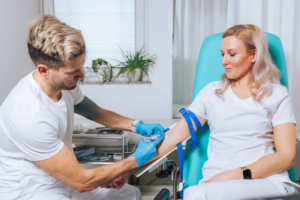
Everyone jokes about the “vampires” that poke us to get blood samples.
The joking comes from most people being scared of needles.
The official title of these professionals is phlebotomist, and they have a very important task.
It is their job to successfully get blood samples to help the medical professionals find out what may be ailing a patient.
They must also be present to successfully prepare patients for IVs that could ultimately save their lives.
Individuals who do this job must patiently deal with some of the most difficult people.
They face those who are terrified of needles, both children and adults.
They must remain calm and calm those who are scared, or those who may be confused as to what is happening.
This includes the mentally challenged, the elderly, and those who are undergoing a medical crisis.
It takes a special kind of person to do one of the most disliked procedures a patient may face.
Not everyone can handle the job.
If you think you can, read on to see what each state requires of its phlebotomists.
States Needing Licenses
The following four states have special licensing requirements for phlebotomists.
The individual state requirements range from a state license to a college degree.
Let’s look at them.
California
The California Department of Public Health requires state certification, and a phlebotomist must complete an approved program and obtain national certification.
Kentucky
Phlebotomists in Kentucky must have the greatest amount of training.
The Kentucky Department for Public Health states that an Associate’s degree plus 100 clinical hours is required, and certification is beneficial.
Nevada
According to the Nevada Department of Health and Human Services, phlebotomists must obtain licensure/certification required through the Division of Public and Behavioral Health.
Washington
The Washington State Department of Health requires phlebotomists in the state to obtain Licensure/Certification as a Medical Assistant-Phlebotomist.
States Needing No License, But Need Special Training
Three organizations offer national certification for phlebotomists.
These certifications are recognized throughout the country and accepted at the majority of health facilities as proof of competency.
They are worth the effort as they give you the upper hand over uncertified phlebotomists seeking the same position.
The National Healthcare Association (NHA) offers a Certified Phlebotomy Technician.
To be eligible, you must have a high school diploma or GED, have completed a phlebotomy course within the past five years, and have completed a minimum of 30 venipunctures and 10 capillary or finger sticks on live individuals.
Alternatively, you can qualify by having your diploma or GED and completing either one year of supervised work within three years or two years of supervised work in five years.
You must also have completed 30 venipunctures and 10 capillary or finger sticks.
Many states don’t have requirements for licensing through the state for phlebotomists, but they do require some type of training and possibly a certificate.
The following states fall into that category.
The American Society for Clinical Pathology (ASCP) requires passing a two-hour test consisting of 80 multiple-choice questions.
The cost is $100, but certain low-income individuals may qualify for reduced fees.
You must maintain nine continuing education hours each period to keep certification.
The American Medical Technologists offers Certification as a Registered Phlebotomy Technician (RPT).
It also offers a choice of three paths toward this certification, plus an additional path for those who teach.
The cost for domestic certification is $125, while international certification costs $155.
The test consists of 200 questions.
Path A: Requires passing an approved phlebotomy course with at least 120 didactic clock hours and a minimum of 50 venipunctures and 10 skin punctures.
Path B: Complete 40 hours of in-classroom training and 160 hours of supervised work in the past three years.
You must also have successfully performed a minimum of 50 venipunctures and 10 skin punctures.
Path C: Complete a minimum of 1040 supervised work hours within the past three years and perform a minimum of 50 venipunctures and 10 skin punctures.
Alabama
The Alabama Department of Public Health states that training is required.
No State Certification Required, but Most Employers Seek It
Arizona
The Arizona Department of Health Services says no state licensure/certification is required, but completion of an accredited training program is necessary.
Connecticut
According to the Connecticut State Department of Health, no state licensure/certification is required, but a phlebotomist must complete a phlebotomy training program.
Georgia
The Georgia Department of Public Health indicates the certification (CPT) for phlebotomists is generally required/expected by most employers.
Hawaii
In Hawaii, no licensure is required, but training is necessary.
ASCP certification is recommended by the Hawaii Department of Health.
Idaho
The Idaho Department of Health and Welfare states that training courses are required to practice, but no license is necessary.
Iowa
The Iowa Department of Public Health governs phlebotomists in Iowa.
They state that no certification is required by law, but phlebotomy training is recommended.
Kansas
Voluntary certification is often preferred for phlebotomists, according to the Kansas Department of Health and Environment, but state licensure/certification is required.
Louisiana
In Louisiana, the Louisiana State Board of Medical Examiners requires licensure through the Louisiana State Board of Medical Examiners for all phlebotomists.
Nebraska
The rule of the Nebraska Department of Health and Human Services is that no license is required for phlebotomists, but they must obtain a certificate and register with the state of Nebraska.
States That Follow Employer-Based Criteria
The majority of states in this country leave it up to individual medical facilities to determine what training or experience a phlebotomist must have.
While smaller towns and smaller facilities may have room for on-the-job training, many employers will give preference to applicants who have at least passed a training course.
Some of the more sought-after positions may require certification at a national level.
Alaska
The Alaska Department of Health and Social Services allows an individual employer to decide what criteria it will set down in order to consider a phlebotomist for hire.
Arkansas
As a phlebotomist in a facility in Arkansas, you will be hired by the criteria set forth, not by the Arkansas Department of Health. but by the individual agency.
Colorado
The Colorado Department of Public Health & Environment entrusts hiring criteria for phlebotomists to the individual medical facilities within the state.
Delaware
A phlebotomist in Delaware must consult individual employers to find out what qualifications they need, as the Delaware Health and Social Services gives this power to the individual employer.
Florida
Medical facilities under the guidance of the Florida Health Department are granted permission to set down their own hiring criteria for phlebotomists.
Illinois
The Illinois Department of Public Health governs medical establishments, but allows the individual establishment to determine what qualifications a phlebotomist needs to be hired.
Indiana
A phlebotomist in Indiana must meet employer qualifications rather than general ones set by the Indiana Department of Health.
Maine
The State of Maine Department of Health and Human Services allows employers under their supervision to use their own hiring criteria for phlebotomists.
Maryland
Medical facilities under the guidance of the Maryland Department of Health can determine what hiring criteria they have for phlebotomists.
Massachusetts
The Massachusetts Department of Public Health trusts employers of phlebotomists in Massachusetts to set hiring guidelines that meet the needs of the organizations.
Michigan
An employer in Michigan is free to set their own hiring criteria for phlebotomists.
This power is given to them by the Michigan Department of Health & Human Services.
Minnesota
Phlebotomists in Minnesota are hired by individual facilities that are governed by the Minnesota Department of Health.
Mississippi
The Mississippi State Department of Health says an individual employer holds the responsibility of hiring qualified phlebotomists.
Missouri
The Missouri Department of Health & Senior Services gives phlebotomist hiring authority to individual employers.
Montana
In Montana, a phlebotomist can be expected to be required to follow the guidelines set down by the employer and not the Montana Department of Public Health and Human Services.
New Hampshire
The medical governing body in New Hampshire is the New Hampshire Department of Health and Human Services.
They allow employers to decide what hiring requirements are needed by phlebotomists.
New Jersey
The New Jersey Department of Health trusts individual medical facilities to provide phlebotomists who are adept at their job, but they are not required to ask for specific training or experience.
New Mexico
Under the supervision of the New Mexico Department of Health, a phlebotomist in New Mexico must seek answers to hiring criteria from individual medical facilities.
New York
Medical facilities under the supervision of the New York Department of Health have control over what they require of phlebotomists they hire.
North Carolina
The North Carolina Department of Health and Human Services is yet another state organization that leaves hiring criteria of phlebotomists up to the organization doing the hiring.
North Dakota
Employers in North Dakota give preference to phlebotomists who are already trained, but the North Dakota Department of Health says they don’t have to require this.
Ohio
A phlebotomist in Ohio can contact the Ohio Department of Health to find out what individual employers may want from an employee.
Oklahoma
In Oklahoma, the Oklahoma State Department of Health states that individual medical facilities can use their own judgment when hiring a phlebotomist.
Oregon
The Oregon Health Authority is the governing body in the state of Oregon.
They leave it up to the employer to determine what is required of a phlebotomist working there.
Pennsylvania
The Pennsylvania Department of Health sets down the rules for medical personnel in this state.
As of now, the individual medical organizations are the ones who are given control of what training they require of their phlebotomists.
Rhode Island
In Rhode Island, some very small clinics will offer on-the-job training, as this is allowed by the State of Rhode Island Department of Health.
Most, however, do require at least a minimum amount of official training.
South Carolina
Phlebotomists in South Carolina have a variety of skills that are mandatory requirements of the individual place they work.
The health organizations themselves are governed by the South Carolina Department of Health and Human Services.
South Dakota
The South Dakota Department of Health states that individual medical facilities can determine their own training criteria for the phlebotomists that are hired.
Tennessee
Working as a phlebotomist in Tennessee can be as easy as having on-the-job training to needing national certification.
This is not determined by the Tennessee Department of Health but instead by individual hospitals and clinics.
Texas
The Texas Health and Human Services states that a phlebotomist is required only to follow the criteria set forth by the individual employer they are hired by.
Utah
Phlebotomists in Utah must contact individual employers to find out what they desire in the way of training and experience.
This is what was stated by the Utah Department of Health.
Vermont
The Vermont Department of Health allows each organization to determine its own hiring criteria for those working in phlebotomy.
Virginia
Some employers in Virginia may hire a person with only training for a phlebotomist position, and others may even be willing to train.
The Virginia Department of Health is the one that gives them this choice.
West Virginia
West Virginia Department of Health and Human Resources states that the employer is the one who decides what is required for the position of phlebotomist in this state.
Many employers give preference to licensed individuals.
Wisconsin
Wisconsin phlebotomists are allowed to work with individual organizations to determine what skills they need to have.
The medical requirements for Wisconsin are determined by the Wisconsin Department of Health Services.
Wyoming
Like the other states in this section, Wyoming leaves it up to the individual employers to determine what kind of training their phlebotomists have.
The department covering regulations is the Wyoming Department of Health.