


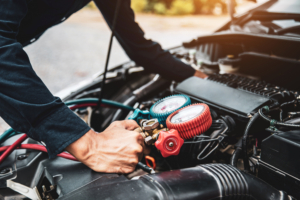
Vehicles have become more complicated, and Joe, the next-door neighbor, is often not able to help out like in the old days.
The good news is that there are training programs to be found everywhere, and mechanics set up businesses very frequently.
Knowing how to do auto mechanic work offers a person a steady income.
Only four states in this country require that an auto mechanic be licensed.
However, most states have some regulations in place regarding setting up a business or being able to work on special systems within a car, such as emissions or air conditioning.
While the majority of states do not require a special license, having one that is issued by a nationally recognized organization can often help in finding a position in an established auto repair business.
It can also allow you to charge more for your services.
Lastly, it will give customers more confidence in you and your ability.
The National Institute for Automotive Service Excellence (ASE) is one of the largest accrediting organizations for auto technicians.
This one will show your competence anywhere in the country.
To obtain it, you must either have a two-year degree in auto repair and one year of hands-on training or two years of hands-on experience.
You must also pass a written test.
The Environmental Protection Agency (EPA) requires all technicians who service motor vehicle air conditioners (MVAC) to obtain certification in proper refrigerant handling according to Section 609 regulations of the Clean Air Act.
Let’s explore the four states that specifically require a license to work as an auto mechanic.
We will then take a look at what you may want to look for when seeking an auto mechanic position in one of the other states.
States Needing a Special License
California
In California, any individual or business that “repairs and/or diagnoses malfunctions of motor vehicles” must register as an Automotive Repair Dealer (ARD) with the Bureau of Automotive Repair.
In other words, if you work on cars other than your own, you need to register.
To get this registration, you must pay $200 and an additional fee for the following:
- Automotive repair dealer – $100
- Smog Check station – $100
- STAR station – no fee
- Vehicle safety systems inspection station – $20
This is a registration that must be renewed on an annual basis.
Connecticut
In Connecticut, you need a Connecticut dealer’s license to repair vehicles legally.
You must provide the Department of Motor Vehicles with:
- Business forms, including estimate orders, repair orders, invoices, loan agreements, etc.
- You must also get a surety bond ($25,000 for general repair, $10,000 for limited repair).
- Fill out a CT Financial Responsibility Insurance Certificate (Form R1325e)
Additional requirements in this state include getting a state certificate to become a Certified Test Inspector or Certified Emissions Repair Technician for the Connecticut Vehicle Emissions Program.
The qualifications for these two certifications are as follows:
- Certified Test Inspector: Complete an online training program and pass a certification exam.
- Certified Emissions Repair Technician: Proof of ASE L1 advanced engine performance specialist training or factory training documents demonstrating your qualifications to work on a specific vehicle make.
The first certificate must be renewed every other year, and the emission repair certificate needs to be renewed every three years.
Hawaii
Auto mechanics in Hawaii must be licensed by the Department of Commerce and Consumer Affairs Motor Vehicle Repair Industry Board.
In order to apply, you must have at least one ASE certification.
If you should pass more ASE tests in the future, you may have them added to your certificate.
In order to get an initial ASE license, you will need to have at least two years of supervised work experience in the industry.
Massachusetts
You don’t need a specific auto mechanic license in Massachusetts, but you do need a Motor Vehicle Damage Repair Shop license to perform work.
To get this license, you will need to provide a few things:
- A copy of a surety bond ($10,000) or a letter of credit
- Two signed letters of recommendation from either a licensed auto repair shop, an auto glass repair shop, an elected official, or a member of the Massachusetts bar.
- Valid appraiser’s license
- Pay the application fee of $450
States Not Needing a License
Alabama
You don’t specifically need a license to work on automobiles in Alabama, but having some type of training or certification can increase your chances of getting a good position.
You must get an Alabama Motor Vehicle Dealer license to operate as a rebuilder or reconditioner.
This is important if you want to expand your customer base.
Alaska
Alaska is a state that requires no formal certification.
Having some experience will help increase your chances of getting employment.
You may be able to find training in most technical schools.
Some even offer reduced or free tuition for lower-income individuals.
Arizona
In Arizona, there is no need for a formal license for auto mechanics.
Many people, however, like to show they have the knowledge needed to get better-paying jobs.
Arizona even has the Arizona Automotive Institute, a place to learn all you can imagine about auto repair.
You may need to obtain certain permits through the Arizona Department of Environmental Quality if you work on emissions.
Arkansas
Auto mechanics in Arkansas do not need to have a license or certificate, but it helps when seeking employment.
Colorado
Colorado is yet another state where a license isn’t required, but having one helps with employability.
Delaware
While Delaware doesn’t require a general license, it does require getting certified to do emission work.
You must apply to become a Certified Emission Repair Technician through the Division of Air Quality at the Delaware Department of Natural Resources and Environmental Control. Requirements include:
ASE L1 advanced engine performance specialist certification (or equivalent)
At least two years of emission repair experience
This certification requires a fee of $125, with renewal required every five years.
Florida
Florida does not have any special requirements for auto mechanics.
You can get training through an official program or through hands-on experience.
It never hurts, however, to get ASE certified in some way.
Georgia
Unless you plan on working on emission systems in Georgia, you won’t need to have any special licenses or certificates.
Vehicles must undergo yearly emissions testing in the 13-county Atlanta metropolitan area.
If you want to be a certified vehicle emission inspector in Georgia, you must complete a two-day training course held by Georgia’s Clean Air Force and pass a written examination.
Idaho
In Idaho, employees very often want their mechanics to have at least one ASE certificate, but the state itself does not require one to work as a mechanic.
For enhanced job prospects, however, getting at least one certificate will help.
Illinois
Illinois requires you to register your business with the local county clerk’s office and the Illinois Department of Revenue if you plan on charging for your services.
This can be avoided if you work for a company, but it must be adhered to if you work freelance.
Indiana
Indiana doesn’t require anything special to work as an auto mechanic.
They do have several educational programs that can enhance your skills should you seek training.
Iowa
The state of Iowa does not demand that its mechanics have either a license or a certificate.
It is very unlikely, however, that you will find a place to be hired because the Iowa Consumer Protection Division advises vehicle owners to specifically seek out ASE-certified mechanics.
Kansas
Kansas leaves it up to individual businesses whether to ask their employees to get a certificate.
Having them do so will help them in their efforts to gain more clients, so having a certificate will enhance your job prospects.
Kentucky
Kentucky also does not require a certificate or license.
Many training programs are available; however, for those who wish to take them to enhance their skills.
Louisiana
Louisiana joins the number of states not requiring auto mechanics to have any special licenses.
With cars getting more complex every year, however, getting certified may help you with job stability.
Maine
Working as an auto mechanic in Maine does not require you to have a license, but they do have some special requirements for some.
Maine requires annual vehicle inspections; however, any individual who performs these inspections or signs inspection certificates must have an inspection mechanic certificate.
To get this certificate, which needs to be renewed every five years, you must apply to the Department of Public Safety’s Bureau of State Police and pass an examination.
Maryland
In Maryland, a license isn’t required, but many professionals in this field get ASE certifications to demonstrate their knowledge and skills.
This helps increase the confidence of consumers.
Michigan
Michigan does not require auto mechanics to have a license, but you must have a professional certification issued by the Secretary of State to work as an auto mechanic.
The types of mechanic certifications are:
- Specialty mechanic
- Master automobile mechanic
- Master heavy-duty truck mechanic
- Master motorcycle mechanic
You must register for individual tests for each automotive category or classification under the certification, and then pass your selected tests with a score of 65 percent or higher.
Michigan also offers mechanic trainee permits, which are good for up to two years, for those without adequate training to pass their certification tests.
Minnesota
Minnesota is open for auto mechanics with no license or certificate.
Again, having some type of certificate will help you during the hiring process.
Mississippi
Mississippi also does not have any particular requirements for auto mechanics.
The more skills you can prove you have, however, the greater your employability.
Missouri
Yet another state that does not have any particular requirements for auto mechanics.
Montana
Montana doesn’t require certification or licensing of auto mechanics.
Nebraska
In Nebraska, the state has no special requirements for auto mechanics.
Nevada
Nevada does not require an auto mechanic to have a license, but every mechanic must register with the DMV if they plan on charging for their repair work.
New Hampshire
Although you don’t need a license in New Hampshire, if you want to work at a shop that performs vehicle safety inspections (a requirement for all vehicles within 10 days of registration), you must attend an educational session hosted by the Division of Motor Vehicles.
This includes instruction and a field test to prove you understand what is required during a proper vehicle inspection.
New Jersey
New Jersey doesn’t require mechanic certification in general, but has special requirements for doing emission work.
Those who perform vehicle emission repairs, however, may need to apply for Emission Repair Technician (ERT) certification through the Department of Environmental Protection.
A licensed Emission Technician must be present at all emission work.
To become an ERT in New Jersey, you must take a free online course and complete an assessment.
You must also have ASE certifications in the following areas:
- A6: Electrical/electronic systems
- A8: Engine performance
- L1: Advanced engine performance
When you apply for recertification in five years, you will once again need to pass the updated testing.
New Mexico
While an auto mechanic does not need to be certified, in some state regions, you can apply to become a Certified Air Care Inspector, which permits you to perform vehicle emissions testing.
New York
In New York, auto mechanics do not need to hold a professional license.
However, you must register your business with the Department of Motor Vehicles (DMV).
In addition, because this state requires car owners to get annual inspections, you must get certification from the DMV, and you must have one of the following:
At least one year of experience repairing motor vehicles in the last five years through employment in the industry or an approved work study program
A high school or vocational school diploma in automotive trades, or a certificate of completion of the first year of college courses toward an associate’s degree in automotive technology
You will also need to pass a written test and will have to renew your license every three years.
North Carolina
Motor vehicles in this state must pass an annual safety inspection.
In some counties, vehicles must pass an emissions test as well.
In order to perform these inspections, mechanics must have a license issued by the Department of Motor Vehicles.
This can only be obtained after completing an approved eight-hour course.
North Dakota
In North Dakota, no license or certificate is required.
Ohio
Ohio runs an emissions testing program in seven counties in the Cleveland and Akron areas.
Each emissions repair facility must employ at least one E-Check certified repair technician.
To earn this, you must be ASE-certified in the following areas:
- A6: Electrical/electronic systems
- A8: Engine performance
Oklahoma
No license or certificate is required in Oklahoma.
Oregon
Oregon has no special requirements for auto mechanics.
Pennsylvania
Certification is needed if you want to complete vehicle safety and emissions inspections.
To become a certified safety inspector or emissions inspector, you must complete a certification course at a school approved by the Pennsylvania Department of Transportation.
You must provide proof of advanced automotive diagnosis and repair training or ASE certification in one of the following areas:
- A8: Engine performance
- L1: Advanced engine performance
- T1: Gasoline engines
Rhode Island
Auto mechanics in Rhode Island must maintain technician certifications to perform the following types of service and repair work:
- Identification and analysis of damage to vehicles
- Frame measuring and straightening systems and techniques
- Welding in collision repair
- Structural steel repairs
- Suspension, steering, and alignment systems
- Safety restraint systems
- Corrosion protection
Anyone doing emission work must also become a Certified Inspection Technician (CIT) or Certified Inspection Repair Technician (CIRT).
This requires taking a four-hour course and a written test.
South Carolina
No license or certification is needed.
South Dakota
South Dakota has no special requirements.
Tennessee
Tennessee also has no licensing requirements.
Texas
Texas has no licensing or certification requirements.
Utah
Utah has a vehicle emissions testing program, and you must complete a training course and pass an exam to become a certified emissions technician.
Vermont
Vermont requires safety and emissions testing for vehicles.
To earn this certificate, you must pass an exam and apply to the state’s Department of Motor Vehicles.
Virginia
To become a licensed emissions inspector, you must complete an automotive emissions inspection course at Northern Virginia Community College (NVCC).
You must complete the advanced ASM emissions diagnostics course at NVCC or hold an active ASE L1 certification as an advanced engine performance specialist.
Washington
No special requirements are set down.
West Virginia
Special requirements apply for those involved in vehicle safety and emissions testing.
You must complete the state’s inspector mechanic training program and undergo an examination conducted by the West Virginia State Police.
Wisconsin
To complete vehicle emissions testing, you must be a licensed emissions inspector.
This requires completion of a training program and passing a licensing exam.
You must renew your license every two years by completing refresher training and testing.
Wyoming
No special requirements in Wyoming.