


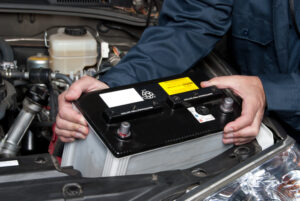
The world runs by being connected through vehicle accessibility, and as auto mechanics, candidates keep people and their vehicles moving by diagnosing and repairing cars and other means of transit.
Many work on cars, vans, and small trucks.
Some auto mechanics work on off-road vehicles, buses, or military transport.
Others specialize in parts like engines, brakes, or tires.
Responsibilities:
- Conducting routine vehicle maintenance.
- Reviewing computer and electronic systems.
- Providing price quotes for work, including labor and parts.
- Keep tools and equipment in excellent condition.
- Communicating information to customers, including suggested maintenance or repairs, and providing an estimated timeframe.
- Maintaining work records for each customer.
To enter the career track of an auto mechanic, candidates need practical skills, a mechanical inclination and dexterity, formal instruction, specialized training, and hands-on experience.
Licensing Requirements
The licensing requirements for working as an auto mechanic vary by state.
Candidates should check the licensing requirements for the state where they plan to work.
In some states, passing a licensing test for each type of repair is mandated, and an application fee is charged.
Training and Education
Candidates should possess a high school diploma or equivalent to become an auto mechanic.
Many employers prefer that auto mechanics finish a program of instruction.
Options for gaining the skills to gain entry and move up the career ladder include automotive training programs, which are often offered in community colleges, vocational schools, and online.
These programs provide hands-on experience and classroom teaching.
Finally, candidates should earn industry-recognized certification, such as that offered by the National Institute for Automotive Service Excellence (ASE), to demonstrate expertise, commitment, and skills to employers.
Tuition costs can range widely, depending on the type of program, the school’s location, public or private, in-state or out, in-person teaching or online learning, and technical institute, career college, or manufacturer-sponsored training.
Associate’s Degrees Community College
Associate degrees in automotive technology are designed to give students an in-depth understanding of automotive repair, including specific techniques and procedures.
Potential career opportunities include automotive technician, glass repairer, distribution manager, and shop foreman.
An associate degree program in auto technology typically runs between $10,000 and $25,000.
Generally, an associate’s degree is completed in two years.
Vocational or Tech Program Certificate Programs
Some candidates learn the skills necessary to succeed as an auto mechanic in an automotive service technology program at a vocational or trade school.
These programs typically cost $6,000 to $20,000 in tuition and fees and last six months to two years.
They combine classroom instruction with practical, hands-on training.
With a broad variety of options, candidates can pay less for a basic certificate or more for one that confers specialized education in specific technologies, brands, or equipment.
Certificate programs can run for 18 weeks or up to two years.
Online Learning
Online automotive training courses begin at approximately $1,000; candidates may also need to consider other expenses such as books, tools, and supplies.
These courses can be completed in six months to two years.
Cost of Books, Supplies, Tools, and Extras
Students can expect to pay extra for books, fees, tools, and miscellaneous costs for college courses, certificate programs, and online learning, ranging from $1,000 to $3,000.
Online certificate programs often include online study materials as part of their fees.
Room and board vary greatly, but if studying full-time during a full-time school year, the cost could add $10,000 or more to a student’s bill.
Some programs offer discounts on tools while students complete their program.
Students can acquire tools individually or secondhand.
A complete kit of tools and a toolbox costs approximately $3,000-$8,000.
Apprenticships
Most auto repair businesses offer apprenticeships to qualified workers.
An apprenticeship as an auto mechanic typically takes two years to complete.
After two years as an apprentice, candidates can begin taking the qualification exams and working towards the relevant certifications.
ASE Certification
Many, if not most, auto mechanic jobs demand Automotive Service Excellence (ASE) certification.
ASE certification tests address most elements of auto repair, and the 58 tests are divided into different series on a specific topic.
Candidates can receive ASE certification after completing a test series.
After completing a series of tests, candidates can earn a Master Technician certification.
Master Technician status must be renewed, and Master Technician mechanics must keep each one of those certifications current to maintain Master Technician status.
There’s a $34 registration fee.
Most tests are $59 each, except L1R, L2R, and L3R, which are $118 each.
Sample topics in the series include:
- Automobile & Light Truck Certification Tests (A Series)
- Auto Maintenance and Light Repair Certification Test (G1)
- Advanced Engine Performance Specialist Certification Test (L1)
- Light Duty Hybrid/Electric Vehicle Specialist Test (L3)
- Medium-Heavy Truck Certification Tests (T Series)
- ASE Military Tactical Wheeled Vehicle Certification Tests (MIL Series)
Career Outlook
According to the Bureau of Labor Statistics, the job outlook for automotive service technicians and mechanics is expected to grow 4 percent from 2024 to 2034, around the average for all careers and jobs.
Over the next decade, 70,000 openings for auto mechanics are expected each year.