


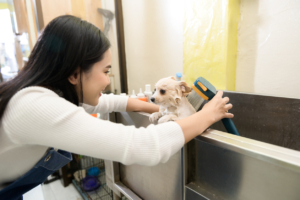
For those who love caring for and nurturing animals, a career as a pet groomer is a natural and rewarding choice!
A pet groomer, as the name implies, is a professional who supports the hygiene, health, and appearance of pets through services that improve health, well-being, and attractiveness, including bathing, brushing, fur-cutting, nail trimming, ear cleaning, and teeth brushing, so that animal companions look great and feel comfortable.
Candidates hoping to work in the industry can find opportunities to enter the field in work settings such as salons, vet clinics, or mobile units.
For candidates with an affinity for the company and a passion for animals, a career as a pet groomer can be a rewarding opportunity on many levels.
Pet grooming sits at the intersection of animal care, small-business savvy, and trust—lots of trust.
However, not every state has a tidy, uniform set of rules for pet groomers.
Across the U.S., regulations range from rigorously structured to lightly supervised to “be good to the dog, please.”
Essential skills include patience and the ability to keep pets calm.
A natural enjoyment of being around animals is vital.
Plus, knowledge of pet handling and safety, awareness of skin and coat health, and technical skills in cutting and styling.
Pet groomers mainly work on dogs and cats.
However, some groomers also groom other common pets, such as rabbits, and specialized groomers can handle horses or more exotic animals, such as birds, lizards, and small rodents, focusing on coat/feather care, nail trims, and overall hygiene.
Recommended Voluntary Certifications
National Dog Groomers Association of America (NDGAA)
Certifications: NDGAA Certified Dog Groomer (CDG), National Certified Master Groomer (NCMG)
The focus is on safety and styling.
Many consider it among the top certifications, respected nationwide.
International Professional Groomers, Inc. (IPG)
Certifications: Certified Professional Groomer (CPG), Master Groomer (ICMG)
The spotlight shines on technique, ethics, safety, and the humane handling of special-needs pets—with attention and international regard for their ethical framework.
International Society of Canine Cosmetologists (ISCC)
Certifications: Pet Styling I & II, Master Pet Stylist
Here, what makes the fur fly is–fur.
The organization is celebrated for its understanding of and work with anatomy, coat types, and complex styling, and is noted for its academically rigorous training.
Animal Behavioral College (ABC)
Certification: ABC Certified Pet Groomer (ABCPG)
The foundations here rest upon equipment safety and stress recognition.
ABC is well-known and yet accessible for beginners.
Steps to Becoming a Pet Groomer
Education & Training
A high school diploma or equivalency is usually the minimum educational attainment for this field.
Candidates should consider educational career training.
This can include grooming classes from grooming schools or online, which can take several weeks to complete, and offer instruction and help support skills and confidence.
Practical Experience
Courses at grooming schools may provide apprenticeship programs.
And on-the-job training at the beginning of a candidate’s career is functional because practical, hands-on experience and skills are essential to the role.
Certification
Candidates committed to building a solid clientele should consider obtaining certification from a respected professional organization, for example, the National Dog Groomers Association of America or the International Professional Groomers.
States that Require a Pet Grooming License
Only a small group of states has established true licensing for pet groomers, including exams, training hours, and adherence to sanitation requirements.
Moreover, there may be additional local oversight in some areas.
Connecticut
- License Required: Yes
- Exam: Yes
- Training Hours: Required; typically 600+ hours through approved programs
- Notes: For independent pet groomers and facilities.
Connecticut treats grooming like a formal animal-care profession, requiring groomers to complete state-approved training and pass a practical exam.
The rules grew out of statewide animal-welfare reforms, and while the process takes time, groomers finish with a well-defined credential that signals authentic competence.
A candidate planning to open a grooming shop here should budget time for the approval process—equipment standards and sanitation inspections are part of the package.
New Jersey
- License Required: Yes (via state Board of Veterinary Medicine oversight)
- Exam: Yes
- Training Hours: Required; varies by approved program
- Notes: Independent groomers and salon employees fall.
New Jersey includes pet groomers in its animal-care regulatory structure.
Pet groomers need to complete an approved program, pass a state exam, and work in accordance with facility rules emphasizing sanitation, equipment safety, and animal handling.
Expect periodic updates—New Jersey’s been refining its pet-care regulations steadily over the last decade.
New York
- License Required: Yes (grooming establishment license + groomer credential)
- Exam: Yes
- Training Hours: Required; varies by approved school
- Notes: NYC adds additional requirements for animal-handling certification
New York regulates both groomers and grooming facilities, making it one of the stricter states.
Pet groomers need to complete a recognized training program and exams.
Facilities go through checks for sanitation, ventilation, and safe equipment.
NYC adds its own layer, mandating enhanced animal-handling training and recordkeeping.
Rhode Island
- License Required: Yes
- Exam: Yes
- Training Hours: Required, and they vary by school
- Notes: Licensing of facilities and state inspections.
Rhode Island is a small state with surprisingly robust rules that take a veterinary-adjacent approach, requiring licensing, exams, and inspections.
Pet groomers train through approved programs and must demonstrate competence in handling tools, recognizing animal stress, and maintaining sanitation.
For candidates opening a salon here, expect close coordination with the state Department of Environmental Management.
States With Mandatory Certification, Training, or Local Requirements (but No State License)
These states don’t issue a “pet groomer license,” but they do impose requirements you must follow—sometimes at the state level, sometimes at the county or municipal level.
Many states require training in sanitation, animal handling, facility operations, or safety protocols.
Several have city-specific rules (looking at you, Los Angeles, Denver, NYC, Dallas).
California
- License Required: No
- State-Mandated Certification/Training: Yes (animal-handling + facility rules)
- Exam: No state exam
- Notes: Los Angeles has stricter local rules for cage dryers, restraints, and supervision.
While the Golden State doesn’t license groomers, it regulates pet grooming through animal-welfare and business statutes.
Pet groomers need to follow rules around equipment, animal restraint, sanitation, and recordkeeping.
The bar’s even higher in Los Angeles, and local provisions limit specific equipment and require active supervision during drying.
And those working in shops, mobile vans, or pet stores need to know both state and municipal expectations.
Colorado
- License Required: No
- State-Mandated Certification/Training: Yes (handling, sanitation; varies by facility type)
- Exam: No
- Notes: Denver has specific local regulations.
Colorado emphasizes animal-handling and safety training as part of its commercial animal-facility requirements.
Groomers working inside pet shops, daycare, or boarding kennels must meet sanitation standards and follow strict procedures for animal segregation, ventilation, and hazard prevention.
Denver adds another layer—its municipal code includes facility requirements and recordkeeping for grooming operations.
Florida
- License Required: No
- State-Mandated Certification/Training: Yes (animal-welfare compliance + facility rules)
- Exam: No
- Notes: Groomers working in pet stores face additional oversight.
Florida’s rules revolve around preventing injury and ensuring safe handling.
Groomers need to comply with sanitation standards, safe restraint practices, and equipment rules—especially in commercial pet facilities.
Chains and large pet stores enforce standardized training that effectively functions as a quasi-requirement.
Anyone working with high-heat dryers or grooming senior pets must document procedures and follow strict protocols.
Georgia
- License Required: No
- State-Mandated Certification/Training: Yes (for animal-care facilities)
- Exam: No
- Notes: Groomers in kennels or daycare must meet extended welfare standards.
Georgia requires staff working in state-regulated animal care facilities, including groomers, to complete training.
Grooming shops operating independently aren’t subject to licensing, but they must meet animal-welfare standards for supervision, sanitation, equipment use, and ventilation.
Illinois
- License Required: No
- State-Mandated Certification/Training: Yes (pet store + shelter staff requirements)
- Exam: No
- Notes: Chicago applies extra consumer-protection rules
Here in the Prairie State, rules regulate commercial facilities.
Pet groomers have to complete safety, sanitation, and humane handling training.
Pet shops and shelters are subject to additional oversight.
And Chicago enforces stricter rules around supervision, recordkeeping, and equipment.
Massachusetts
- License Required: No
- State-Mandated Certification/Training: Yes (animal-handling + facility compliance)
- Exam: No
- Notes: Localities may add additional rules.
Massachusetts doesn’t license groomers, but the state expects anyone working in grooming shops or kennels to follow its animal-care and sanitation codes.
Training is required at the facility level, covering stress recognition, safe restraint, proper use of drying equipment, and hygiene.
Towns sometimes add extra rules—especially around high-heat dryers.
Nebraska
- License Required: No
- State-Mandated Certification/Training: Yes (for pet shop and kennel employees)
- Exam: No
- Notes: Pet groomers in regulated facilities must follow state inspection rules.
Nebraska requires animal-handling and sanitation training for anyone working at a licensed pet shop or kennel.
That includes groomers, who must follow the state’s rules for segregation, safe restraint, disinfectant protocols, and reporting animal injuries.
Nevada
- License Required: No
- State-Mandated Certification/Training: Yes (commercial animal-care rules)
- Exam: No
- Notes: Las Vegas adds stricter facility requirements.
Nevada regulates pet grooming through its commercial animal-care standards, mandating training in sanitation, safe equipment use, and animal handling, and requiring facilities to undergo inspections and maintain detailed cleaning logs.
In Las Vegas, there are also enhanced standards on drying equipment and supervision.
Oregon
- License Required: No
- State-Mandated Certification/Training: Yes (animal-handling + sanitation rules)
- Exam: No
- Notes: Pet groomers in boarding facilities have additional requirements.
Oregon’s animal-welfare rules require training for groomers working inside pet-care facilities.
Staff must know how to safely handle stressed animals, use restraints properly, and maintain sanitation.
Facilities are inspected for equipment safety and hazard prevention.
Texas
- License Required: No
- State-Mandated Certification/Training: Yes (facility-based requirements)
- Exam: No
- Notes: Dallas has stricter local rules for restraint and supervision.
Texas regulates grooming through its commercial animal-care facility standards.
Pet groomers need to follow sanitation, restraint, ventilation, and equipment safety protocols.
In addition, Dallas imposes some of the most rigid rules in the state, including supervision requirements and limits on unattended drying.
Washington
- License Required: No
- State-Mandated Certification/Training: Yes (for pet shops and boarding facilities)
- Exam: No
- Notes: Additional rules apply in some localities.
In Washington, training in handling, sanitation, and emergency procedures for all employees of animal-care facilities, and yes, this includes pet groomers.
Shops must maintain cleaning logs and comply with state inspections.
States With No State Licensing or Mandatory Certification Requirements
These states don’t require pet groomers to hold a license or complete state-mandated training programs.
That doesn’t mean there are no rules—it just means groomers operate under fundamental animal-welfare laws, consumer-protection regulations, and standard business requirements.
Most employers (especially chains) require training even when the state doesn’t.
Below are the states where pet grooming is governed primarily by professional norms and facility-level expectations:
Alabama
The Lizard State doesn’t license groomers, and the state leaves training standards to employers and facility owners.
Groomers must abide by animal-cruelty and sanitation laws, and shops must maintain safe conditions, but no formal credentials or coursework are required.
Alaska
In Alaska, there’s no grooming license and no training mandate, though facilities are still accountable under animal-welfare statutes.
Pet groomers are expected to follow safe-handling practices, especially in remote regions where veterinary services may be limited.
Arizona
Arizona imposes no formal grooming credentials.
Groomers operate under general business rules and animal-welfare laws that prohibit neglect, unsafe restraint, and unsanitary conditions.
Arkansas
While Arkansas doesn’t regulate groomers directly, anyone offering grooming services needs to follow general safety and cruelty-prevention laws, and employers handle training privately.
Delaware
Grooming shops must maintain safe conditions and comply with consumer protection laws, but no formal credentials are required, and Delaware doesn’t have a specific license for groomers.
Hawaii
Hawaii doesn’t license groomers; however, the Rainbow State expects basic safety and sanitation, and grooming facilities must comply with general animal-care rules.
Idaho
In Idaho, there are no state requirements for pet groomers.
The profession is self-regulated, with training determined by employers and industry standards.
Indiana
The Gem State doesn’t require grooming licenses or certifications.
However, pet groomers must follow general animal-welfare rules, but there are no specialized regulations for salons or mobile groomers.
Iowa
Iowa imposes no grooming certification or licensing rules.
Pet groomers operate under statewide cruelty-prevention statutes and general business standards.
Kansas
Kansas doesn’t regulate grooming credentials as long as pet groomers maintain safe conditions and humane practices; no specific training is mandated.
Kentucky
Kentucky requires no license or training for groomers.
Professional standards vary by employer, and the state relies on general animal-welfare codes.
Louisiana
The Pelican State has no grooming license, but pet groomers must follow cruelty-prevention laws.
Maine
Maine does not license groomers and has no statewide training requirement.
Grooming facilities must maintain sanitary conditions and comply with consumer protection rules.
Maryland
Maryland leaves grooming unregulated, with no licensing or mandated coursework, but pet groomers must follow the state’s animal welfare and safety laws.
Michigan
The Wolverine State goes wild, with no grooming license and no compulsory training.
Employers typically handle skills training, and shops must maintain safe, clean environments.
Minnesota
Minnesota imposes no licensing or certification requirements for pet groomers, and general animal-welfare laws apply.
Mississippi
In Mississippi, there’s no regulation for pet groomers through licensing or state-mandated training.
However, pet groomers are expected to follow basic safety and humane-handling practices.
Missouri
Missouri doesn’t mandate a state license for pet groomers.
Shops need to comply with consumer protection and sanitation laws, but there are no formal credentialing requirements.
Montana
In Montana, Big Sky Country, pet grooming is unregulated; however, groomers are subject to general animal-care laws, with training handled privately.
New Hampshire
New Hampshire has no grooming-specific regulations.
Pet groomers follow the state’s cruelty-prevention laws.
New Mexico
The Land of Enchantment doesn’t license pet groomers.
However, facilities must maintain safe conditions, but no training is mandated.
North Carolina
North Carolina imposes no grooming license or required coursework.
Groomers operate under general safety rules and facility expectations.
North Dakota
While North Dakota doesn’t regulate groomers directly, it relies on cruelty-prevention laws to govern the safe handling of animals.
Ohio
Ohio has no licensing or mandatory training requirements for pet groomers, and shops must maintain clean environments and comply with consumer protection rules.
Oklahoma
The Sooner State imposes no requirements on pet groomers beyond general animal-welfare laws.
Pennsylvania
Pennsylvania regulates commercial kennels.
However, the state doesn’t require a license or specific training for groomers, and pet groomers operate under general welfare rules.
South Carolina
South Carolina has no state-level regulation for pet groomers.
Training is handled entirely at the employer level.
South Dakota
South Dakota does not regulate pet groomers.
No license, certification, or state-mandated training is required.
Tennessee
Tennessee imposes no grooming-specific requirements.
Pet groomers must follow basic anti-cruelty statutes and maintain safe handling.
Utah
Utah has no formal regulation of the grooming profession, but industry standards govern training and safety practices.
Vermont
Vermont doesn’t require grooming licenses, and pet groomers follow general animal-safety laws and basic sanitation expectations.
Virginia
Virginia does not license groomers and doesn’t require mandatory training.
Pet groomers work under general animal-welfare laws and business regulations.
West Virginia
West Virginia leaves grooming unregulated.
No credentials are required, and training is left to individual businesses.
Wisconsin
The Badger State has no licensing or training requirements for pet groomers, who operate under general animal-safety laws.
Wyoming
While Wyoming doesn’t regulate grooming, safe handling, and humane treatment are required, and no credentials are mandated.