


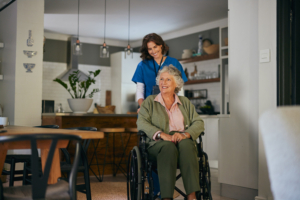
For individuals seeking a way into the caring profession, a career as a home health aide can be an excellent choice.
Home health aides help older people and those with disabilities or chronic illnesses with the daily activities of living, and work under the supervision of other healthcare providers to deliver more advanced care, including administering medication and checking vital signs.
Home health aides support people in living comfortably and with dignity, often in their own homes.
Nevertheless, home health and personal care aides work in a range of settings, including clients’ homes, as well as group homes and day service programs.
Becoming a home health aide offers candidates flexibility, job stability, and the opportunity to make a meaningful difference in individuals’ lives.
The field is growing due to an aging population, so it provides job security and opportunities to develop professionally and to find a niche and specialization.
Becoming a home health aide offers candidates flexibility, job stability, and the opportunity to make a meaningful difference in individuals’ lives.
Since requirements vary between states, reviewing your state’s specific training, education, and certification rules is essential to ensure compliance and success.
Step 1: Educational Requirements to Enter the Field
To start on the road to a rewarding career as a home health aide, the minimum educational attainment to begin training is generally a high school diploma or equivalency.
Step 2: Apply for a Training Program
Home health aide programs can be found in many avenues, ranging from community colleges and private schools to employers that offer training opportunities.
Community college programs usually take a year to complete, and private school programs often require around 75 hours.
Some employers may offer on-the-job training, but generally don’t offer formal training.
The fastest programs can get you up and running in around 4–7 weeks.
Home health training programs demand classroom learning and clinical training.
Tuition generally costs $400–$800. Be sure the program is certified by your state.
Step 3: Meet the Program Requirements
Each state has a minimum education and training requirement set by Federal law: for example, many require at least 75 hours of training, including 16 hours of supervised practical and clinical training, and some states mandate up to 120 hours of training.
Step 4: Pass an Evaluation
Once a candidate has completed training and program requirements, the next step is to apply for testing and certification through your state.
Testing requires demonstrating competency in a written exam and a skills evaluation.
Step 5: Entry Into the Profession
Many home health aides enter the profession through a home health agency, and many health agencies need proof of training and certification, an interview, and a background check.
Outlook
The role of home health aid is a growing profession.
The US Bureau of Labor Statistics predicts 17 percent job growth from 2024 to 2034, much faster than most occupations, offering promising opportunities for career development.
Responsibilities:
- Personal care: Assisting with bathing, dressing, and grooming, and personal hygiene.
- Household tasks: Light housekeeping, like laundry and cleaning, and simple meal prep.
- Health monitoring: Checking and reporting vital signs, such as pulse, temperature, and respiratory rate. Home health aides may report on a client’s physical/mental condition to healthcare professionals.
- Medication reminders: Supporting clients in taking their medication.
- Transportation: Providing or arranging transportation.
- Companionship and support: Social interaction, emotional support, and companionship.
- Exercise assistance: Helping with simple prescribed exercises.
- Safety and emergencies: Monitoring the home environment for safety and assisting in case of emergencies.
- Record keeping: Documenting care and any relevant observations.
The Three Central Regulatory Systems for Home Health Aides
The regulatory systems across all 50 states range from strict licensure to open-market practices.
Here, they’re divided into three central regulatory systems.
States That Require a Home Health Aide Licensure or Mandatory Registration
In these states, the career of a home health aide is regulated.
Candidates must complete state-approved training, pass required evaluations, and, in many cases, register or be listed before they can work.
Alaska
Alaska is one of the more regulated states.
In the Last Frontier state, home health aides must meet state standards, including:
- Governing body: Alaska Department of Commerce, Community & Economic Development
- Training / Certification: State-approved HHA program
- Exam / Competency: Yes, an exam is needed, plus supervised clinical hours
- Scope / Notes: Applies to both privately funded home care and Medicaid/Medicare home-health services, and compliance is mandatory for agencies.
Maine
Maine, being Maine, sets high standards for home health aides.
- Governing body: Maine Department of Health & Human Services
- Training: Long-form training required
- Competency / Exam: Mandated, including practical skills demonstration
- Scope: HHAs can perform commissioned personal care under supervision
Ohio
Ohio requires certified home health aides for home-health service agencies.
- Governing body: Ohio Department of Health
- Training: 75-hour standard HHA program (including clinical hours)
- Competency Evaluation: Skills and knowledge testing needed for agency-employed aides
Oregon
Oregon regulates both home health aides and home care agencies — a dual-layer approach.
- Governing body: Oregon Health Authority
- Training: HHA training program with required classroom and clinical hours (minimum 75 hours)
- Competency / Exam: Yes, skills evaluation and employer verification for certification are needed
- Scope: Strict guidelines — HHAs handle ADLs and basic personal care; medical/nursing tasks need licensed staff
States That Don’t Require a “License” But Do Require State-Approved Training or Certification
Here are the states that do not mandate a formal home health aide license, yet they regulate who can work as a home health aide by enforcing certification, minimum training hours, and competency evaluations.
For many agencies, these rules are mandatory (especially those billing Medicare/Medicaid).
California
The Golden State requires:
- Requirement: State-approved HHA certification
- Training: 120-hour program (classroom + clinical) — higher than the 75-hour federal baseline
- Competency Evaluation: Required; aides often need to pass written and skills tests before being placed
Florida
Florida offers a flexible pathway, depending on employer or agency type.
- Requirement: One of three approved routes — 40-hour HHA course, 75-hour certificate, or post-secondary diploma from an accredited school
- Competency / Certification: Required for state-licensed home-health agency employment; federal 75-hour + competency rules apply for Medicare/Medicaid agencies
New York
In New York, here is what home aides need to begin work:
- Requirement: State HHA certificate after completion of an approved training program and competency evaluation.
- Training: 75-hour standard course including classroom and clinical instruction; state-approved curriculum and competency testing are mandatory
Vermont
Vermont takes a hybrid approach, requiring home health aide candidates first to be Licensed Nursing Assistants (LNAs).
- Requirement: LNA credential first (80-hour training + state exam), then additional HHA-specific training
- Notes: This shows home health aides have basic nursing-assistant skills.
Wisconsin
In Wisconsin, the requirements are:
- Requirement: CNA credential (which enables HHA-type work) —
- Training: CNA program including classroom + clinical hours
- Certification / Registry: CNA certification and registry
Wyoming
Wyoming doesn’t have a stand-alone home health aide license.
Instead:
- Requirement: CNA certification is standard; some agencies add 16 hours of supplementary “home-care aide” training for Medicaid-funded work
District of Columbia (Washington, D.C.)
Washington, D.C. mandates:
- Requirement: State-sanctioned HHA certification
- Training: 75-hour course including 16 hours of supervised clinical training
- Competency / Evaluation: A criminal background check is often required
States With No Statewide Licensing or Certification Requirement for Home Health Aides
In these states, there’s no formal state HHA license, and no mandated statewide certification program.
Instead, agencies or employers — often those reimbursed by Medicaid or private payers — set their own standards.
Because state-by-state licensing requirements, training hours, supervision, background checks, and the scope of care vary widely, the importance of these factors is significant.
Moreover, home health aides working under Medicaid or long-term care waiver programs must at least meet the federal baseline standard — typically 75 hours of training, including 16 hours of clinical or supervised practical experience.
States with Minimal or Flexible State-Level Requirements
Alabama
Alabama doesn’t license home health aides at the state level.
However, aides working for Medicaid-funded or Medicare-certified agencies must meet federal requirements: a minimum of 75 hours of training (this training has 16 hours of supervised practical work/experience), successful completion of a competency evaluation, and periodic skills assessments.
Arizona
Arizona does not require a state license or registry for home health aides.
The Copper state follows federal CMS guidelines when working for Medicare-certified home health agencies.
Arizona requires fingerprint‑based background checks for direct-care workers serving vulnerable adults.
Arkansas
Arkansas does not issue a specific HHA license, but home health aides employed by Medicare-certified agencies must meet federal standards.
Agencies serving Medicaid recipients may also impose additional competency checks.
Colorado
Home health aids generally complete training under the supervision of a registered nurse when working for certified home health agencies, although Colorado doesn’t require a state-level license.
Georgia
While Georgia doesn’t require a specific home health aide license, aides working in Medicare-certified agencies must follow federal training and competency guidelines.
Many employers conduct background checks, and some require TB testing and CPR certification.
Idaho
Idaho has no state licensing requirements for home health aides.
However, those employed by Medicare-certified home health agencies must meet federal standards, including the 75‑hour training requirement; direct‑care workforce programs promote additional training, especially for home health aides working in rural or remote areas.
Indiana
Home health aides follow federal requirements when employed by Medicare-certified agencies.
Indiana does not issue a home health aide-specific license, although agencies generally expect home health aides to pass a competency evaluation, and many earn the CNA certification.
Iowa
Iowa does not require a state-issued HHA license, while home health aides in Medicare-certified agencies must meet federal training requirements.
Because the state regulates home health agencies, not individual aides, most employers include background screenings, abuse registry checks, and ongoing skills education.
Kansas
Kansas does not mandate a Home Health Aide license.
However, home health aides working for certified home health agencies must follow federal CMS requirements.
Kansas also maintains abuse registry screening for workers serving vulnerable populations.
Kentucky
Home health aides in Medicare-certified programs need to meet federal training and competency requirements.
Kentucky requires criminal background checks for direct-care workers, and many agencies require CPR certification and TB testing.
Maryland
In Maryland, home health aids working for Medicare-certified agencies follow federal guidelines.
And Maryland mandates criminal background checks for direct-care workers and encourages continuing education.
Michigan
Michigan does not license home health aides at the state level.
Aides who work for Medicare-certified home health agencies must meet federal CMS requirements, and Michigan emphasizes “competency-based” training.
Mississippi
Federal training standards apply when aides work in Medicare-certified agencies.
However, Mississippi doesn’t require state licensing.
Because the state serves large rural regions, many agencies provide training in emergency response, transportation challenges, and work in remote settings.
Missouri
Although Missouri doesn’t license home health aides, those employed by certified home health agencies need to follow federal standards.
Missouri maintains a Family Care Safety Registry that employers can check before hiring direct-care workers.
Montana
Montana doesn’t demand state licensing or maintain a specific home health aide registry; however, aides employed by Medicare-certified home health agencies must comply with federal training requirements.
Agencies often provide additional training focusing on independent decision‑making and safety in remote areas.
Nebraska
Nebraska does not license home health aides.
Federal training standards apply to aides working in Medicare-certified agencies.
Background and abuse registry checks are standard, and Nebraska’s health system encourages continuing education.
Nevada
Nevada does not demand a state-issued HHA license.
Yet federal standards apply to aides working in Medicare-certified home health agencies.
Nevada does mandate state and FBI background checks for personal care aides.
New Hampshire
New Hampshire does not issue a home health aide license.
Home health aides employed by Medicare-certified agencies must meet federal training and competency rules, and background checks and TB screening are standard.
New Jersey
New Jersey does not license home health aides unless they perform certified homemaker–home health aide duties under CNA supervision.
For standard roles, federal CMS requirements apply to Medicare-certified agencies, and New Jersey requires criminal background checks for direct-care employees.
New Mexico
While New Mexico doesn’t require a state-level HHA license, aides employed by Medicare-certified home health agencies must follow federal training guidelines, and background checks are standard.
Workforce development programs offer voluntary training in cultural competency, chronic disease support, and home safety.
North Dakota
While North Dakota doesn’t have a home health aide-specific license, those working in Medicare-certified agencies must meet federal training requirements.
Many North Dakota agencies encourage aides to complete CNA training, and abuse registry checks and background screenings are necessary for direct-care workers.
Ohio
Ohio does not issue a separate home health aide license; however, aides working in Medicare-certified agencies follow federal training and competency standards, and the Buckeye state requires criminal background checks for all direct-care employees.
Oklahoma
Oklahoma doesn’t require a state-issued Home Health Aide license.
Yet, federal training and competency standards apply in certified home health agencies, and Oklahoma runs background checks through its statewide systems for all direct-care employees.
South Carolina
South Carolina does not license HHAs or maintain a specific registry.
That said, home health aides employed by Medicare-certified agencies must meet federal requirements.
South Dakota
Working as a home health aide in South Dakota doesn’t require a license or certificate.
Agencies often handle training, following federal Medicare standards when serving Medicare clients.
Expect supervised practice, competency checks, and infection-control training, and rural agencies often upskill home health aides into hybrid personal-care roles.
Tennessee
Tennessee imposes no licensure requirement for home health aides.
Training expectations vary by employer, but Medicare-certified agencies follow the 75-hour federal minimum.
Texas
Agencies determine required training; Medicare agencies must follow federal competency guidelines; however, Texas does not license HHAs individually.
However, many Texas agencies prefer CNA training, even when it is not required.
Utah
Utah has no state-level HHA license.
Agencies often provide their own training aligned with federal requirements.
Utah Delegation rules: Home health aides can assist with ADLs but can’t perform nursing tasks unless the supervising nurse delegates a limited function under established protocols.
Vermont
Vermont does not license home health aides for home-care agencies.
For home health roles, training is employer-based and needs to align with federal Medicare regulations.
Virginia
While Virginia has no home health aide licensing requirement, agencies set training expectations, and those receiving Medicare funding follow federal standards.
Washington
Washington doesn’t license home health aides.
But agencies do follow federal Medicare rules.
Note: Washington’s large health systems often offer paid training programs, which can help candidates enter the field.
West Virginia
There is no home health aid licensure requirement in West Virginia.
Training is set by employer policy and federal rules for Medicare agencies, and delegation is RN-driven.
Wisconsin
Note that although Wisconsin doesn’t require a state home health aide license, many agencies strongly prefer—or even require—completion of a CNA program, and some agencies provide training that meets federal requirements.
Wyoming
Wyoming does not demand a stand-alone home health aid credential.
Agencies generally require CNA training plus additional in-house instruction (around 16 hours), and rural agencies often invest heavily in cross-training to help aides cover widespread service areas.
Washington, D.C.
Washington, D.C., does not issue an HHA license, but does require at least 75 hours of training, which includes a minimum of 16 hours of supervised practical experience, when working for agencies certified under federal regulations.