


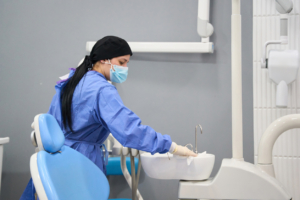
Whenever you have visited a dental office for a routine cleaning or other procedure, you likely spoke with a dental assistant.
These dental professionals assist staff with procedures like extractions and fillings, schedule appointments, and take X-rays of your teeth.
For those interested in entering this field, every state has a different licensing requirement for dental assistants.
Some states have no requirements, while others require certification, training, or registration.
Before choosing the dental assistant career path, it’s important to understand your specific state requirements.
Keep reading to learn more!
States Requiring a Dental Assistant License
Requirements within each state range from simply holding a high school diploma to finishing a certification course for every dental assisting skill.
States that require a dental assistant license include:
California
California is one of the strictest states, with the California Board of Dental Examiners requiring the following:
- A dental assistant training program.
- A course on the Dental Practice Act.
- A radiation safety course.
- An eight-hour infection control course.
- CPR certification.
- Dental assistant certification.
- Dental assistant licensure.
The licensure process requires all of the above to be completed before applying, then a background check, passing a drug screening test, and submission of all training documents.
Indiana
The Indiana State Board of Dentistry requires all dental assistants to be trained and certified, followed by licensure in radiation safety and health to work.
Licensure options include passing the DANB radiation safety and health course or becoming a Certified Dental Assistant.
The safety and health course finishes with an examination, followed by applying for licensure through the State governing body.
Also, the Board of Dentistry requires annual continuing education credits in radiology.
Iowa
Like Indiana, Iowa also requires dental assisting training, passing a certification examination in radiology, and being registered with the state for licensure.
The Iowa Dental Board also mandates candidates to complete annual radiology continuing education credits.
For dental assistants seeking to expand their functions, they must be trained in restorative functions, monitoring nitrous oxide processing, and coronal polishing.
Maine
The Maine Board of Dentistry mandates that all dental assistants hold a high school diploma, be at least 18 years old, pass a training program in radiation safety and health, pass the Maine Board of Dental Examiners exam with at least 85 percent correct, and apply for a license through the Board.
Once hired, dental assistants must maintain their license through annual continuing education credits.
Maryland
The Maryland Board of Dental Examiners also requires dental assistants to hold a license and certification through training.
Maryland is one of the few states with an in-state certification exam, which permits dental assistants to assist with procedures and take X-rays.
To become a dental assistant, candidates must complete a State-approved training program and then pass the Maryland General Dental Assisting exam.
The last step is to register with the Board to gain licensure and work.
Massachusetts
The State of Massachusetts also requires dental assistants to hold a license by completing a CDC compliance training course.
While dental assistant certification is not required, applicants must earn a CPR certification and pass the Board’s jurisprudence and ethics exam.
Once this is complete, the candidate is eligible to register with the Massachusetts Board of Dentistry for licensure.
Minnesota
The Minnesota Board of Dentistry requires entrants to pass a state-approved exam, certification exam, the Minnesota State exam, complete CPR training, and then apply for licensure.
The only requirement for the state application is to submit and pass a background check.
In addition to required training, certification, and licensure, the State also requires working dental assistants to complete annual continuing education credits.
New Jersey
The New Jersey Bureau of X-ray Compliance requires dental assistants to be licensed and certified to work.
Candidates must earn the DANB Certified Dental Assistant certification or pass the DANB Radiation Health and Safety exam.
Additionally, applicants must pass a New Jersey-approved dental radiography course and then apply for licensure with the state.
New York
The New York Registered Dental Assistants mandates that all dental assistants are licensed, certified, and have completed a training program.
Candidates are also required to be CPR certified and must complete annual continuing education requirements for their licensure to remain current.
Ohio
Ohio dental assistants must earn a CPR certification, complete a six-hour nitrous oxide administration course, finish a radiation health and safety training, provide proof of vaccination against hepatitis B, and become licensed.
The Ohio State Dental Board also requires dental assistants to complete annual radiology continuing education coursework.
Oklahoma
The Oklahoma Board of Dentistry does not have certification or training requirements for dental assistants new to the field.
However, candidates must apply to the State, pass a background check, and register to become licensed before starting work.
Vermont
The Vermont Board of Dentistry requires candidates to complete an emergency procedures course within 30 days of their employment start date.
After the training is complete, the dental assistant must apply to the State for licensure.
States That Do Not Require Licensure but Mandate Certification or Training
Alaska
Although dental assistants in Alaska are not required to be licensed or certified for basic duties, those who want to add restorative functions and coronal polishing must complete a training program ending with certification.
The certification must be earned through the state governing body, the Alaska Board of Dental Examiners.
Arizona
The Arizona Board of Dental Examiners does not require dental assistants to earn a license or certification for basic tasks, but they must be successful during employer training.
However, those who wish to perform coronal polishing must be CPR-certified and pass a training course with a certification exam at the end, offered by the Board.
Arkansas
The Arkansas State Board of Dental Examiners does not mandate licensure for dental assistants.
However, training and certification for those who will be administering nitrous oxide and X-ray imaging are required.
As an alternative, those who become registered dental assistants can conduct X-rays and nitrous oxide monitoring and perform more complicated tasks like dental sealants and coronal polishing.
The State requires applicants to also hold CPR certification for both options.
Colorado
Colorado only mandates certification for radiation safety training, which can be fulfilled by completing five hours of clinical or practical experience and three hours of lecture.
As an alternative, candidates can pass the DANB Certified Dental Assistant or the DANB Radiation Health and Safety exams.
Once certified, dental assistants must complete radiation safety training yearly to remain current on their certification.
Connecticut
Like Colorado, Connecticut-based candidates must hold a radiation safety certificate.
CPR certification and dental assistant licensure are not required by the state to practice.
Applicants must be successful on the DANB radiation safety certification exam to offer x-ray imaging to clients in a dental office, which is a basic function of the position, and annual radiation safety continuing education is required.
Delaware
Delaware also requires radiation safety certification, but licensure and CPR certification are not mandated.
Candidates must pass the DANB radiation safety training, followed by an examination for the Delaware Board of Dentistry and Dental Hygiene to permit working.
Like most other states, annual continuing education related to radiation safety is required to continue working.
Florida
The Florida Board of Dentistry mandates dental assistants to complete a state-approved training program, followed by radiation safety certification from the Florida Department of Health.
Neither CPR certification nor licensure is required to work, but radiation safety continuing education credits must be completed each year.
Georgia
The Georgia Board of Dentistry mandates a six-hour radiation safety training offered by the state for dental assistants to begin their career.
Once this training is complete, dental assistants are not required to complete continuing education credits to keep working.
For those who want to work on more advanced tasks like coronal polish and restorative function, DANB training and passing the examination are required.
Also, the state requires CPR training for those who are present when a patient receives nitrous oxide.
Kentucky
Although the Kentucky Board of Dentistry does not mandate certification or licensure, the State requires training in radiology safety and health before starting in a dentist’s office.
To fulfill these requirements, candidates can pass the DANB Radiation Health and Safety examination or complete a Kentucky Board of Dentistry-approved course in radiation technique and safety.
Once working, annual radiation safety continuing education credits are required.
Michigan
The Michigan Board of Dentistry requires dental assistant candidates to pass a dental radiology course before entering the workforce.
However, no certification or licensure is required beyond the course completion.
For those looking to conduct advanced tasks, applicants can pass the Board’s clinical and comprehensive exam, complete two hours of bias training within five years before registration, and finish a one-time human trafficking training.
This allows candidates to apply for a Registered Dental Assistant designation.
Mississippi
While the Mississippi State Board of Dental Examiners does not require new dental assistants to complete a training program or earn a license, they must acquire a CPR certification within 180 days of their work start date.
Montana
Montana-based dental assistants must complete a training program in radiography before working in an office.
The training must be from a Montana Board of Dentistry-approved program, which includes certification from the U.S. military in dental radiology.
Another option is to receive a certificate from DANB.
Nebraska
Candidates who wish to work in Nebraska must complete a training program and pass the DANB certification exam, and then they will receive the Certified Dental Assistant credential.
Additional training is required for those who want to expand their abilities to include coronal polishing.
The Nebraska Department of Health and Human Services requires all dental assistants to complete continuing education credits for certification renewal.
New Hampshire
The New Hampshire Board of Dental Examiners requires budding dental assistants to finish a State-approved radiology training program and then pass the Certified Dental Assistant or DANB Radiation Health and Safety exams.
Once certified, licensure is not required by the State.
New Mexico
The New Mexico Regulations and Licensing Department does not have any requirements to become a dental assistant.
Employers want candidates with a high school diploma or a higher degree.
Those who want to conduct special tasks in the dental office, like coronal polish or fluoride application, must complete a task-specific training course followed by passing a DANB exam.
North Carolina
The North Carolina Board of Dental Examiners instructs all dental assistants to be certified after completing a training program.
Candidates must complete a radiation safety course and then pass the DANB Radiation Health and Safety Examination.
These potential professionals can reach the full scope of work by completing all DANB Level 2 requirements.
The Board does not require dental assistants to hold a license to work.
North Dakota
The only requirement from the North Dakota Board of Dental Examiners is for candidates to be CPR certified.
The State does require training and passing examinations for advanced activities like restorative functions, coronal polishing, and nitrous oxide administration.
Oregon
A basic dental assistant does not have training, certification, or licensure requirements.
Employers only require a high school diploma and then offer on-the-job training.
However, the Oregon Board of Dentistry requires those who want to expand their roles to be able to complete special training, including:
- Anesthesia Monitor
- Expanded Function Dental Assistant
- Expanded Function Dental Assistant with Restorative Functions
- Anesthesia Dental Assistant
- Expanded Function Orthodontic Dental Assistant
- Anesthesia Dental Assistant with IV Therapy
- Expanded Function Preventive Dental Assistant
Pennsylvania
The Pennsylvania Board of Dentistry mandates incoming dental assistants to complete radiology training before working.
To expand their duties, these professionals can pass a State-approved dental assistant training course and three hours of child abuse recognition education.
Rhode Island
The Rhode Island Board of Dentistry requires applicants to complete a radiography course and one hour of infection control coursework annually.
Those who want to expand their knowledge must pass the DANB Certified Dental Assisting exam.
Candidates must also become CPR certified to work in the State.
South Carolina
Although the South Carolina Board of Dentistry does not require licensure, dental assistants must be CPR certified if they work with sedated patients and complete radiation safety and infection control training before starting work.
Dental assistants are required to complete biannual infection control training to keep their certification active.
South Dakota
The South Dakota Board of Dentistry only requires licensure, CPR certification, dental assistant certification, and a training program completion for those interested in the following advanced functions:
- A dental assistant qualified in the injection of medication
- Dental assistant with a permit to administer nitrous oxide
- Dental assistant with a permit to monitor patients under anesthesia or sedation
- Dental assistant with training in IV lines
- Radiography
- Registered dental assistant
The most basic dental assistant does not have any requirements.
Tennessee
Tennessee-based dental assistants must finish a radiology safety training and certification program or be enrolled in a dental assisting training program.
Candidates must also hold a CPR certification and earn continuing education credits every year to maintain the certification.
The State does not require licensure.
Wyoming
Although the Wyoming Board of Dental Examiners does not require candidates to be certified, they must complete a Board-approved training program and become CPR certified when the dental assistant is performing sedation monitoring.
Dental assistants also have the option to advance their duties by completing training in pit and fissure sealing.
States With No License Requirement but Have Employer-Based Standards
Alabama
The Dental Assisting National Board of Alabama does not require a training program, certification, any continuing education, or licensure.
The only state-mandated requirement is for candidates to hold a high school diploma.
The State permits dental assistants to conduct tasks like helping with bedside procedures, taking x-rays, and applying fluoride after completing on-the-job training.
Hawaii
Hawaii does not have any licensure, certification, or training requirements for those working in the State.
However, candidates must hold a high school diploma to be eligible for a position.
Once working, new dental assistants must be supervised and directed by a licensed dentist.
Idaho
Idaho also doesn’t have any requirements to become a dental assistant, other than a high school diploma.
The State also requires a licensed dentist to be present to supervise and direct all dental assistant activities in an office.
Illinois
Although the Illinois Board of Dentistry manages dentist licensure, its reach does not extend to dental assistants.
As a result, there are no requirements in the State, other than a high school diploma to be hired and supervision of a licensed dentist to work in a dental office.
Kansas
The Kansas Dental Board does not have any training, certification, or licensure requirements.
Only a high school diploma is mandated, and all dental assistants must work under a licensed dentist.
Louisiana
The Louisiana State Board of Dentistry does not require training, certification, or licensure to work in the State.
Only a high school diploma is required to be hired, and a licensed dentist must be present to supervise and direct all dental assistants in each office.
Missouri
The Missouri Board of Dentistry does not require dental assistants to be licensed, certified, or complete a training program.
Candidates must hold a high school diploma for employment and be managed by a licensed dentist.
Nevada
The Nevada State Board of Dental Examiners does not mandate any requirements for dental assistants other than that a licensed dentist must be present when these professionals are on duty.
All employers require candidates to hold a high school diploma.
Texas
The Texas State Board of Dental Examiners only requires dental assistants to work under the supervision of a licensed dentist.
Employers require candidates to hold a high school diploma to be eligible for a dental assisting position.
Utah
Utah also doesn’t have any requirements other than management by a licensed dentist.
Although the Utah Board of Dentistry does not require a high school diploma to work, employers want this designation to prove the candidate can learn how to do the job effectively.
Virginia
Virginia does not have any certification, licensure, or training program requirements to start working as a dental assistant.
Employers require a high school diploma to be eligible for all positions.
Washington
The Washington Board of Dentistry has no requirements for dental assistants to conduct basic tasks.
West Virginia
Those seeking dental assisting work in West Virginia do not need to complete a training program, become certified, or apply for licensure.
Wisconsin
Wisconsin-based dental assistants do not need to register with the State for licensure, become certified, or complete a training program.