


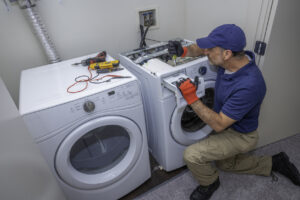
The appliance repair technician career is great for the individual who aspires to make the environment clean, safe, and comfortable by installing new home appliances, including refrigerators, dishwashers, washing machines, and other machinery in homes and offices.
They also advise clients on the use and maintenance of appliances, perform maintenance procedures, identify and fix damaged or defective appliance parts, and check to make sure that the appliance works correctly after the repair.
What skills or traits make for a great appliance repair technician?
An understanding of technology and problem-solving skills is the beginning.
Physical stamina and dexterity are useful.
Appliance repair technicians also need good communication and customer service skills, the ability to keep an accurate inventory of appliance parts, equipment, and tools, the ability to read manufacturer manuals, and administrative skills for keeping up with paperwork and collecting payments.
Appliance repair technicians have generally earned a high school degree or equivalency.
While candidates often receive on-the-job training, they need to acquire the skills and credentials to land that first job.
Credentials and Licensing
A general appliance repair technician is generally not mandated to have certifications, but specific appliances, like refrigerators, may need them.
Licensing requirements vary from state to state, so candidates for the appliance repair technician career should check the standards of the location where they plan to practice.
Organizations like the Professional Service Association (PSA) help candidates stay current on the latest appliances, technology, and repair methods.
Appliance repair technicians often drive to appointments, so having a valid local driver’s license is helpful.
Specialization in types of appliances, including gas or smart home appliances, can lead to career success and open up career opportunities.
Expenses
It’s important to note the specifics that influence the costs of each school.
The costs of a school can vary depending on the type of degree or certificate, the school’s duration and location, and whether it is a public or private institution.
Education
Candidates should note whether the school is a vocational, trade, community college, or four-year institution.
Public schools generally have lower tuition, and in-person schools often have lower fees for in-state residents rather than those paying out-of-state tuition.
Tuition
There are considerations in acquiring the skills to become an appliance repair technician.
Certificate programs generally have lower educational costs and are of shorter duration.
Public trade and vocational schools offer low tuition rates, and for-profit trade schools often charge higher rates.
Four-year academic college degrees tend to be the most expensive option, although some schools may offer scholarships.
Earning a four-year Bachelor’s degree can be helpful for career advancement, and some candidates may focus on studying math, consumer technology, and electronics-related subjects.
The average cost of a 4-year in-state tuition is $10,000 yearly.
A community college offering courses towards an Associate’s degree in appliance repair can help students advance in the profession.
Tuition for a two-year degree is $3,500 annually.
In-person vocational programs generally range from $3,500 to $15,000 and often lead to specialized training, such as the Major Appliance and Refrigeration Technician program in 14 months from Penn Foster.
Online programs leading to career certificates for entry-level appliance repair technician jobs can be completed in several months to a year.
The starting price for a two-month course is $1,000.
Textbooks and Supplies
A four-year college, on average, runs to $1,220 annually for textbooks and supplies.
A 2-year community college, with an average of $1,467 each year for books and supplies.
Vocational programs may run from a few hundred to a few thousand dollars for textbooks and other supplies.
Online programs that can help candidates enter the field may sometimes include digital textbooks and materials.
Vocational training may cost a few hundred to a few thousand dollars for textbooks, career-specific equipment, and other supplies.
Room and Board
The cost of housing and incidentals will depend on location and the accommodation type, whether solo or sharing, on or off-campus.
Whether the space is in an urban area or a small town.
Or rooming with family or friends.
4-year college or university: room and board during the school year, $12,917.
At a 2-year community college, room and board average $7,717.
Certification and Professional Organizations
While not mandatory, certifications, such as the National Appliance Service Technician Certification from the International Society of Certified Electronics Technicians (ISCET), can help candidates advance.
Earning the NASTeC, a certification program for technicians servicing major home appliances, proves competence and inspires confidence in clients and employers.
The test to earn certification includes fees:
- Basic Skills $50
- Each Specialty $65
- Basic plus one Specialty $115
- Basic plus two Specialties $160
- Basic plus all three Specialties (Universal) $185
All NASTeC certifications must be renewed every 2 years.
Key Takeaways
Education is one way to acquire the skills and experience needed to become an appliance repair technician.
Candidates should consider the cost and time commitment to best meet their needs.
Keep in mind that prices are affected by public vs. private institutions and in-state vs. out-of-state tuition.
Certification can lead to career advancement.
Professional organizations can help with networking and keeping up with industry trends.