


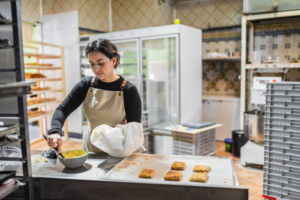
For most people, bakeries are places of wonder where they can get the sweetest, cutest baked goods that taste heavenly.
Wouldn’t it be fun to be a baker, you think to yourself.
It could be fun.
However, working as a baker is somewhat romanticized.
Yes, you may get a chance to produce those neat cakes and cookies, but there’s more to the job than that.
You have to have a clear picture of the pros and cons of being a baker before pursuing that dream.
Pros of Being a Baker
1. You May Have a More Regular Daily Routine at Work
This depends on where you work, but if you’re employed in a supermarket bakery or one where you have a regular pastry, bread, and cake selection, your daily routine is likely to be much more regular than that of other cooks.
You’d have a standard amount of certain baked goods to produce each day, which is conducive to forming a routine that you and your co-workers can fine-tune for efficiency.
If you’re not a fan of not knowing what comes next, or you don’t like having to constantly shift what you’re doing as random orders come in, something a line cook would have to deal with, being a baker could be more your style.
2. You Get to Smell That Baking Bread
This is admittedly subjective, but online comments from people who have worked as bakers sometimes mention that the bakeries do smell good.
It’s a minor thing, but it can make your day seem a little nicer.
This doesn’t always apply, of course, especially if you have to work with a pungent ingredient like durian.
3. You Get to Sample That Baking Bread (and Pastries)
Even better is the fact that you’ll often get to sample that bread or cake, or those pastries.
This depends on your bakery’s policies.
Some allow bakers to have a free roll or pastry when they take a break, or if the bakery is working on a new product, you might get to be a taster.
Like other cooks, you may find yourself occasionally sneaking a taste of frosting or another ingredient during the day, but be aware that it isn’t always approved behavior.
4. More Opportunities for Creativity
If you’re working with cakes and decorating or have a boss who loves to serve new products, being a baker could give you more chances to let your creativity run wild.
Many of the world’s most famous pastries and cakes were created by bakers who were just experimenting.
Some products were accidents that bakers then refined.
When you interview at bakeries to find a job, you can ask about the level of creativity allowed when making the recipes or planning the day’s dessert menu.
5. You Can Find Work in the Wildest of Places
Bakers actually have a lot of opportunities to work in a wide range of places.
There are restaurants, standalone bakeries, and supermarket bakeries, of course.
But there are also schools, hospitals, universities, company cafeterias, and even a boutique bakery at your home, if your city allows home food preparation for commercial sale.
You might score a position in a factory that makes baked goods for other institutions or for retail sale.
It’s even possible to get baker positions at research stations in remote locations like Antarctica.
There aren’t too many jobs like that, obviously, but they exist.
You can also take your skills overseas if you don’t find what you’re looking for here.
6. You Might Not Need That Much Training
While you can go to school to become a pastry chef, you don’t always need that much training to start working as an entry-level baker.
Some bakeries will train on the job, starting you off with simple duties.
Other places may want you to have rudimentary baking skills.
The point is that not every bakery will insist that you have a degree from a French culinary institute before you even look at a spatula.
7. You Can See How Happy Customers Are With Your Work
If you’re baking in a bakery or market where you make customized cakes and assorted other goods, you’ll likely be able to see how happy customers are with your work.
From looks of delight when someone finds a fresh batch of their favorite bread, to the wide eyes and smile of someone satisfied with the custom cake you decorated, you will have a lot of moments where you know someone is appreciating your work.
Cons of Being a Baker
1. Burns, Cuts, and More Potential Injuries
Being a baker means working in a kitchen with ovens, knives, rolling pins, bread slicers, and more sharp and dangerous things.
It’s a given that at some point, you’ll get at least one burn on your arm from the side of a hot baking sheet; you may also end up with some cuts if you’re not careful.
Your hands, wrists, arms, shoulders, and back can all end up very sore after a long day, and if you have to do a lot of repetitive motions, carpal tunnel syndrome is a major risk.
Lifting heavy equipment can put your back at risk, so remember to lift with proper form.
2. Baker’s Lung/Baker’s Asthma
A particular danger in bakeries is something called baker’s lung or baker’s asthma.
Bakers are exposed to clouds of flour and other fine particles, and the repeated exposure can lead to asthma.
Pre-asthma symptoms can include allergy-like symptoms and even conjunctivitis (pink eye).
Your skin can also start to react, although you might not register as allergic to anything on a traditional allergy test.
There are historical reports of Roman slaves working as bakers and using mask-like protection for their faces.
Newer cases of baker’s asthma can get better on days when that baker isn’t at work.
However, if you continue to work in a bakery for a long time after developing baker’s asthma, you may find that you’re beginning to have symptoms even when you’re not at the bakery.
Note that it typically takes a very long time for baker’s asthma to occur; you really aren’t going to develop it after one day.
But it can sneak up on you.
Also, be aware that there have been claims that bakers have an increased risk of lung cancer, but studies haven’t yet backed up that claim conclusively.
3. Lifting, Cleaning, Kneading, Stirring, Slicing: It’s Tiring
Being a baker is tiring.
You will continually be stirring, kneading, lifting bags and equipment, slicing bread, and cleaning things each and every day with little rest during work hours.
And be aware that some of the equipment in bakeries is huge.
You’re not using countertop mixers; you’re using giant industrial mixers where the bowl is at least a couple of feet wide and tall, if not bigger.
And you get to lug that thing over to the wash area to clean it every day.
4. Very Early Shifts Are the Norm
Most bakery jobs that rely on having products ready for customers by a morning opening time will start very early.
Some can start as early as 1 a.m. and run for a good nine to 10 hours.
If you’re lucky, you’ll find a bakery that starts later in the day.
But be prepared for many of your bakery jobs to begin in the very early hours of the morning.
5. Lunch Breaks Might Not Be Regular
At a bakery, you’re beholden to the schedule set by the items baking in the oven.
That means you might not get to take a normal lunch break in the middle of your shift, especially if the bakery is understaffed.
State law will deem a certain amount of time for lunch, but it won’t necessarily require your employer to let you have lunch at a particular time.
6. Steep Learning Curve Regarding Kitchen Climate and Baking
Baking is heavily impacted by ambient temperature and humidity in the bakery.
You’re going to have to learn very quickly about how to adjust your recipes if the day turns out to be very humid, for example.
7. Cocoa Powder Can Be a Menace
Cocoa powder is a terrific ingredient, but bakers online have complained about how it can get everywhere.
You are probably going to have to spend time cleaning up streaks of cocoa powder, even if you didn’t think you spilled any.
8. Customers Can Be Unrealistic
Some customized cake orders aren’t very realistic.
The customer may want the cake quickly when the bakery is already swamped with orders, or the customer may have misconceptions about various ingredients.
They may try to change their order at the last minute, too.
All of that is frustrating to bakers.
9. Depending on the Workplace, No Regular Holidays or Weekends
Some bakeries will be closed on weekends or holidays.
A baker in a university cafeteria likely won’t need to go to work over the Christmas break.
But those working in markets and bakeries will likely have to work on weekends and over holidays to satisfy customer demand.
10. You Can’t Leave Work for the Next Day
Short-staffed?
Lots of orders to fill?
In many cases, baking must be done that day, which means you stay until it’s finished instead of leaving some of the baking duties for the next day.
Pros and Cons of Being a Baker – Summary Table
| Pros of Being a Baker | Cons of Being a Baker |
|---|---|
| You May Have a More Regular Daily Routine at Work | Burns, Cuts, and More Potential Injuries |
| You Get to Smell That Baking Bread | Baker's Lung/Baker's Asthma |
| You Get to Sample That Baking Bread (and Pastries) | Lifting, Cleaning, Kneading, Stirring, Slicing: It's Tiring |
| More Opportunities for Creativity | Very Early Shifts Are the Norm |
| You Can Find Work in the Wildest of Places | Lunch Breaks Might Not Be Regular |
| You Might Not Need That Much Training | Steep Learning Curve Regarding Kitchen Climate and Baking |
| You Can See How Happy Customers Are With Your Work | Cocoa Powder Can Be a Menace |
| Customers Can Be Unrealistic | |
| Depending on the Workplace, No Regular Holidays or Weekends | |
| You Can't Leave Work for the Next Day |
Should You Become a Baker?
You can see that the “con” list is longer than the “pro” list, but that doesn’t automatically mean you shouldn’t be a baker.
If you truly love baking, then being a baker remains a viable career choice for you.
If you don’t mind the cons or think you can work with them, you could find being a baker rewarding.
However, be realistic in your assessment.
If you’re not sure you want to go to work at 3 a.m. or find yourself ruminating over the potential for injuries, you may want to reconsider.
Keep this in mind: You can always try it, and then change your mind if you don’t think it will work for you.